 Random Pokemon Generator
Umbreon Weakness (2x)
Fighting Bug Fairy
#197 · Dark · Moonlight Pokemon · Gen 2
Umbreon is the Eevee family's night shift: a mono-Dark wall that trades hitting power for 130 Special Defense with 110 Defense behind it. You do not catch one, you raise it.
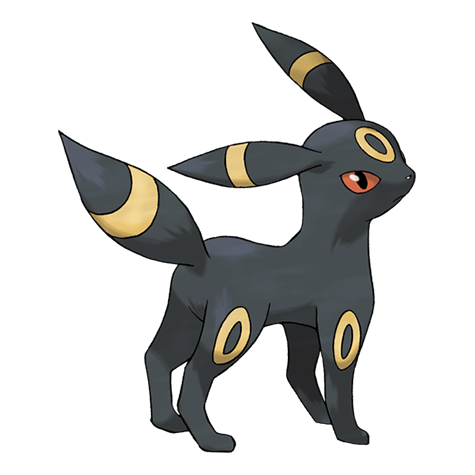
BST 525
Abilities: Synchronize · Inner Focus (hidden) · Evolution stage: final
The matchups above follow the full 18-type grid on the Pokemon Type Chart, including the modern reading of Dark versus Psychic.
Fighting Bug Fairy
Ghost Dark
Psychic
The Eevee page covers where this one starts, and Gengar covers the other side of the night.
The wall of the Eevee family
Number 197 comes out of Johto and Generation 2, and it arrives the awkward way: an Eevee that reaches high friendship, then levels up at night. There is no stone and no trade involved. The typing is single Dark, the abilities are Synchronize with Inner Focus tucked behind it, and the evolution line stops here.
The stat line explains the whole personality. 95 HP, 110 Defense and 130 Special Defense make it hard to shift, while 65 Attack, 60 Special Attack and 65 Speed mean it will not be knocking much out. Eevee has eight evolutions these days, and Umbreon is the one built to outlast rather than to finish.
Dark brings three resistances and no immunity: Ghost, Dark and Psychic moves all land for half. In the older games the Psychic entry read as a flat immunity, and the modern chart softened that to a resistance, so anyone coming back after a long break should read the card rather than trust memory.
On the other side of the sheet are three weaknesses. Fighting, Bug and Fairy each double up, and Fairy is the newcomer of the group, added when the type arrived in Generation 6. A mono-type build like this has a short, memorable list in both directions, which is exactly what you want on a wall.
Start with the 130 in Special Defense. That single number is the reason the Pokemon exists on competitive teams and on casual ones alike: it walks into special attackers and simply does not care. The 110 Defense underneath covers the physical side well enough that neither column is a soft target.
The cost is visible in the other three columns. 65 Attack, 60 Special Attack and 65 Speed mean Umbreon loses damage races badly, and it usually moves last. Its answer is a support kit rather than a strong one: recovery, status, and Foul Play, which deals damage based on the target's Attack stat instead of its own. That one move is why a Pokemon with 65 Attack still makes physical attackers think twice.
Fighting, Bug and Fairy double up on it. Ghost, Dark and Psychic come back at half, and nothing lands at zero. The practical version: watch for a Fighting coverage move, expect Fairy on special attackers, and treat a Ghost-type opponent as a comfortable switch-in rather than a threat.
Because those three resistances cover a lot of common attacking types, Umbreon slots into fights that would wear down a frailer team. It is not a Pokemon you send out to win a turn; it is one you send out to make the next five turns easier. That is also why it fits badly on hyper-offensive teams, where its patient style has nothing to work with.
Friendship evolutions mean planning, so start on paper. Map the run in the Nuzlocke Team Builder, roll for the encounters you still need with the Random Pokemon Picker, and sort the finished six in the Pokemon Team Picker.
The details matter more than usual here, because a wall only works if the numbers line up. Set the nature through the Pokemon Nature Chart, verify the spread in the Pokemon IV Calculator, and when two options look identical, hand the call to the Pokemon Wheel Spinner or Who's That Pokemon.
Colour variants run through their own set of pages: base odds sit in Pokemon Shiny Odds, the Random Shiny Pokemon Generator rolls the hunt for you, and the Random Mega Pokemon Generator picks up the big-form end of the dex.
Eevee is the only Pokemon family with this many branch points, and two of them are a matched pair: Umbreon for the night, Espeon for the day. Same starting Pokemon, same friendship requirement, different clock. Raising one means deciding which of the two you want before the level-up happens. Stones and trades play no part, which is why the family shows up in so many guides: the branch depends on a hidden counter and the in-game clock rather than on anything you can buy.
That branch is also why the line is popular in challenge runs. A single Eevee is a real decision rather than a formality, and the Dark typing gives the family something it otherwise lacks: a member that can sit in front of special attackers for an entire battle without support.
Umbreon rarely produces a highlight. It produces the absence of one for the other team. A special attacker that cannot break it, a Toxic clock that keeps running, recovery that cancels out the chip damage the opponent spent turns building up. Games like that are decided slowly and without much drama.
For anyone building a first wall, that is the lesson the Pokemon teaches: defence is not a number you check once, it is the shape of a matchup over ten turns. Umbreon is one of the clearest examples of that in the dex.
FAQ
Umbreon is a single-type Dark Pokemon, which gives it three resistances and three weaknesses with nothing immune. Ghost, Dark and Psychic attacks all land for half damage.
Fighting, Bug and Fairy each hit it for double damage. Against those, its 130 Special Defense and 110 Defense buy time rather than safety, so a switch is usually the better answer.
An Eevee becomes Umbreon by reaching high friendship and then levelling up at night. No stone, trade or item is involved, and the change is permanent once it happens.
Synchronize is the standard ability and Inner Focus is the hidden one. Synchronize passes a burn, poison or paralysis back to whoever caused it, which suits a Pokemon that expects to take status moves.
One step and then a stop: Eevee to Umbreon at high friendship during the night, with nothing evolving out of Umbreon afterwards.
Absorbing special attacks. A 130 Special Defense stat plus recovery and status moves make it a wall first and an attacker a distant second, which is why it usually runs support moves over coverage.