 Random Pokemon Generator
Gengar Weakness (2x)
Ground Psychic Ghost Dark
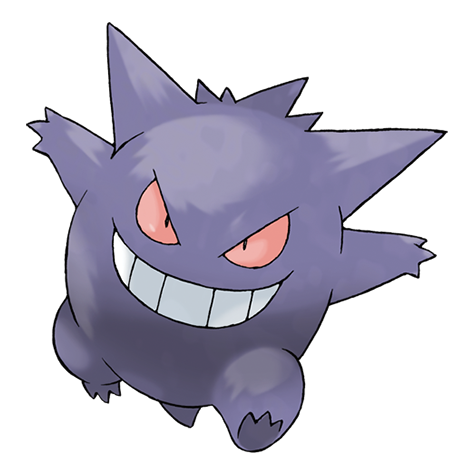
#094 · Ghost / Poison · Shadow Pokemon · Gen 1
The shadow Pokemon, and the reason a generation of kids checked their closets twice. Gengar is a Ghost/Poison type with a 500 base stat total — a glass cannon with a grin, and the best story the original dex ever told.
BST 500
Abilities: Cursed Body · Evolution stage: final
From the full 18-type grid on the Pokemon Type Chart.
Ground Psychic Ghost Dark
Grass Poison Bug Fairy
Normal Fighting
The pokedex is growing — these pages are live now.
Pokemon stats and facts
Gengar is Pokemon number 94 in the national dex and the last stage of the Gastly line. It carries the Ghost and Poison dual typing, a 500 base stat total, and exactly one ability — Cursed Body — which is about as uncluttered as an ability line gets. Three stages, one region, and a reputation that has outlasted nearly everything else from its generation.
Defensively the two halves of the typing do real work: four types double (Ground, Psychic, Ghost and Dark), four bounce off (Grass, Poison, Bug and Fairy), and Normal and Fighting do nothing at all — two free switch-ins that most Pokemon can only dream about. A Ghost that shrugs off a Hyper Beam and fires back is the whole pitch. The resist list is not decoration either: a Grass, Poison, Bug or Fairy attacker hands it a free turn to set up or swing.
The pairing works because the two halves cover different fears: Poison deals with the Fairies and Grass types that expect a clean shot at a Ghost, and Ghost ignores the Normal and Fighting moves that would wreck an ordinary Poison type. What it does not cover is the fast special side — Ground, Psychic, Ghost and Dark — and those are the four to scout for.
The stats agree with the typing: this is a hit-first Pokemon. Sp. Atk 130 is the engine, Speed 110 is the delivery system, and between them they define the role before a single move gets picked. Sp. Def 75 and Defense 60 are the price of doing business — Gengar wins by moving before the answer arrives.
Read the six numbers: 60 HP, 65 Attack, 60 Defense, 130 Sp. Atk, 75 Sp. Def, 110 Speed. Two numbers do all the talking — Sp. Atk 130 and Speed 110 — and the rest of the card exists to support the plan: 60 HP means a stray crit is a real threat, and 65 Attack means physical sets are a gimmick, not a build. Treat the health bar as a resource you spend, not one you protect.
At 110 Speed it outruns most of what it meets, and that is the whole survival strategy for a card this light on defense: hit first, hit hard, and let the answer arrive too late. The line tops out here at 500 base stats, up from Haunter's 405, and 500 lands right on the typical final-stage mark near 509. Build around the Sp. Atk, patch the Defense if the run can afford it, and let the Speed do the rest. The three-stage family also means the payoff arrives late: this is the version of the line that makes the wait worthwhile.
In practice the scouting list is short: Ground, Psychic, Ghost and Dark are the four types that actually threaten this slot, and Ground is the one that shows up on gym rosters. Everything else either bounces off or does nothing — Grass, Poison, Bug and Fairy land soft, and Normal and Fighting walk straight through with no effect. Cover the Ground matchup and the weakest link is gone.
The rule of thumb: switch it in on anything that throws Normal or Fighting moves, pull it out the moment something faster shows up, and let the Sp. Atk do the talking while it is in. Few Pokemon are this clear about what they want to do. Give it the lead when the matchup reads clean, and it will close the fight before the rest of the squad needs to care.
For Nuzlocke planning, the trick with Gengar is the handoff: Gastly and Haunter are fragile even by early-route standards, and the payoff only shows up when the final stage lands. The Nuzlocke Team Builder sets the rules, and the Random Pokemon Picker fills any empty slot with one clean draw. On a finished team it slots in as the fast special attacker that ends fights before they get long. When nobody wants to make the call, the Pokemon Wheel Spinner decides.
The shadow at the end of the route is usually Gengar's job: fast, special, and gone before the counter lands. The Pokemon Team Picker shows how that speed slots into the six without doubling up on roles, and the Random Mega Pokemon Generator digs out Mega Gengar once Mega Evolution is on the table. Ghost/Poison coverage is not common in a casual six, which is exactly why the slot works. A white-Gengar hunt gets its numbers from Pokemon Shiny Odds and its rolls from the Random Shiny Pokemon Generator. The Blog goes deeper on natures, odds and challenge rules.
FAQ
Gengar is a Ghost and Poison dual type: weak to Ground, Psychic, Ghost and Dark, resistant to Grass, Poison, Bug and Fairy, and completely immune to Normal and Fighting. Neutral everywhere else, and the two immunities are the headline — most of the physical dex cannot touch it at all.
Ground, Psychic, Ghost and Dark, all at double damage — with Ground as the one that shows up on gym rosters. Normal and Fighting do nothing at all, and Grass, Poison, Bug and Fairy come in at half power. The rest of the chart is neutral. Re-check the matchup card before a gym, a rival battle, or any fight that actually matters.
Gastly becomes Haunter, and Haunter becomes Gengar — three stages, Ghost/Poison the whole way, and every step permanent. The final form is where the whole family's payoff lives, so the middle of a run is really a countdown to it.
Cursed Body is the only ability Gengar has, and it fits the theme: a chance to disable the move that just connected, turning a hit taken into a threat removed. There is no hidden second slot to plan around — what you see on the card is the whole list.
Three stages end to end: Gastly, Haunter, and Gengar — the same Ghost/Poison typing at every step. A level-up at 25 starts it; a trade with a friend finishes it.
Sp. Atk 130 is the highest number in the spread by a wide margin, and it is the whole reason the slot exists: hit first, hit from the special side, and let the 110 Speed make sure the answer comes late. Everything else on the card is built around protecting those two numbers. In practice: open with it, keep it fast, and never ask it to survive a second turn.