 Random Pokemon Generator
What Are Full Odds? The 1/8192 Baseline
A shiny Pokemon is a differently colored variant — same stats, same moves, zero gameplay advantage. People hunt them because they're rare, full stop. "Full odds" means hunting with zero help: no charm, no breeding tricks, no sandwiches. Just you against the base rate, and from Gold and Silver in 1999 through Black 2 and White 2, that base rate was 1 in 8,192.
I want to say my first shiny was a Zubat in Union Cave, but honestly it might have been any cave in any Gen 2 game. What I remember is the sparkle, and then panicking because I was a kid who didn't know what it meant. Most players of those games never saw one at all, which is fair — the rate was not built to be seen.
The number itself comes from 16-bit math, verified in the game code and documented on Bulbapedia for years: the engine compared a hidden personality value against a range that left 8 winning combinations out of 65,536. 8/65,536 reduces to 1/8,192 — 0.0122% per encounter.
The "average" full-odds hunt is 8,192 encounters, and the average is close to useless. Each encounter is an independent roll, so about 36.8% of hunters reach 8,192 with nothing, and 13.5% reach double that. Flipping the question around gives numbers you can actually plan with: at exactly 8,192 encounters, the chance of having found at least one shiny is only about 63%. The 50% mark arrives near encounter 5,678. A 90% chance takes roughly 18,862. The Pokemon Shiny Odds calculator does this conversion for any rate — type in the odds, get the encounter counts.
Base Shiny Odds by Generation
The base rate has changed exactly once in the entire history of the series — and Pokemon.com is where official confirmations land when it does. Pokemon X and Y (Gen 6, 2013) quietly doubled everyone's luck, widening the winning range from 8 to 16 out of 65,536 — 1 in 4,096, about 0.0244%. Every mainline game since then, including Legends: Arceus, the Let's Go pair, and Scarlet and Violet, starts from that 1/4,096 base before any boosts — you can cross-check each game's rates on Serebii, which tracks them generation by generation. So if someone tells you shinies "used to be rarer," they're right, and they're underselling it — they were twice as rare, for fourteen years.
| Generation / Era | Games | Base shiny odds | As a percentage |
|---|---|---|---|
| Gen 2 | Gold, Silver, Crystal | 1 in 8,192 | 0.0122% |
| Gen 3 | Ruby, Sapphire, Emerald, FireRed, LeafGreen | 1 in 8,192 | 0.0122% |
| Gen 4 | Diamond, Pearl, Platinum, HeartGold, SoulSilver | 1 in 8,192 | 0.0122% |
| Gen 5 | Black, White, Black 2, White 2 | 1 in 8,192 | 0.0122% |
| Gen 6 | X, Y, Omega Ruby, Alpha Sapphire | 1 in 4,096 | 0.0244% |
| Gen 7 | Sun, Moon, Ultra Sun, Ultra Moon, Let's Go | 1 in 4,096 | 0.0244% |
| Gen 8 | Sword, Shield, BDSP, Legends: Arceus | 1 in 4,096 | 0.0244% |
| Gen 9 | Scarlet, Violet | 1 in 4,096 | 0.0244% |
Gen 2 is a special case. Shininess came from IVs rather than a personality value, so the odds landed on the same 1/8,192 while the mechanic underneath was completely different — a Gen 2 shiny transferred into a modern game still carries its odd stat spread. Game Freak clearly knew a 1/8,192 mechanic was effectively invisible: Gold and Silver hard-code a red Gyarados at the Lake of Rage, a guaranteed shiny encounter that exists so every player would run into the mechanic at least once.
How the Masuda Method Works: the 1/683 Math
The Masuda Method is named after Game Freak director Junichi Masuda, who described it on his own blog after Diamond and Pearl shipped — Bulbapedia's breakdown of the method covers the mechanic's history in detail. Breed two Pokemon from games of different real-world languages — an English Ditto and a Japanese Garchomp is the classic pairing — and every egg gets several shiny rolls instead of one. In Gen 4 and 5 that's five rolls per egg, moving 1/8,192 to about 1/1,639. From Gen 6 onward it's six rolls against the doubled base rate: 6/4,096, about 1 in 683, or 0.146% per egg.
"Extra rolls" is not a metaphor. The game doesn't make a single roll luckier — it runs the check repeatedly and counts any hit as a success, so gains multiply in rolls rather than percentage points. It also only applies to eggs, which matters more than people expect: wild encounters, raids and static Pokemon don't benefit, and legendaries can't be bred, so most of the famous marathon hunts are full-odds or charm-only grinds by necessity.
Stacking the Shiny Charm: the Road to 1/512
The Shiny Charm is the reward for completing the Pokedex, and it permanently adds two extra rolls to every eligible check for the rest of your save file. On its own in a modern game, that takes 1/4,096 to about 1/1,365 (3/4,096). But the charm and Masuda both add rolls, and rolls simply add together: six Masuda rolls plus two charm rolls is eight rolls per egg — 8/4,096, exactly 1 in 512, or 0.195%. That's the 1/512 quoted all over the hunting community, and it's just 6+2 over 4,096 — walkthrough sites like Game8 carry the same stacks game by game.
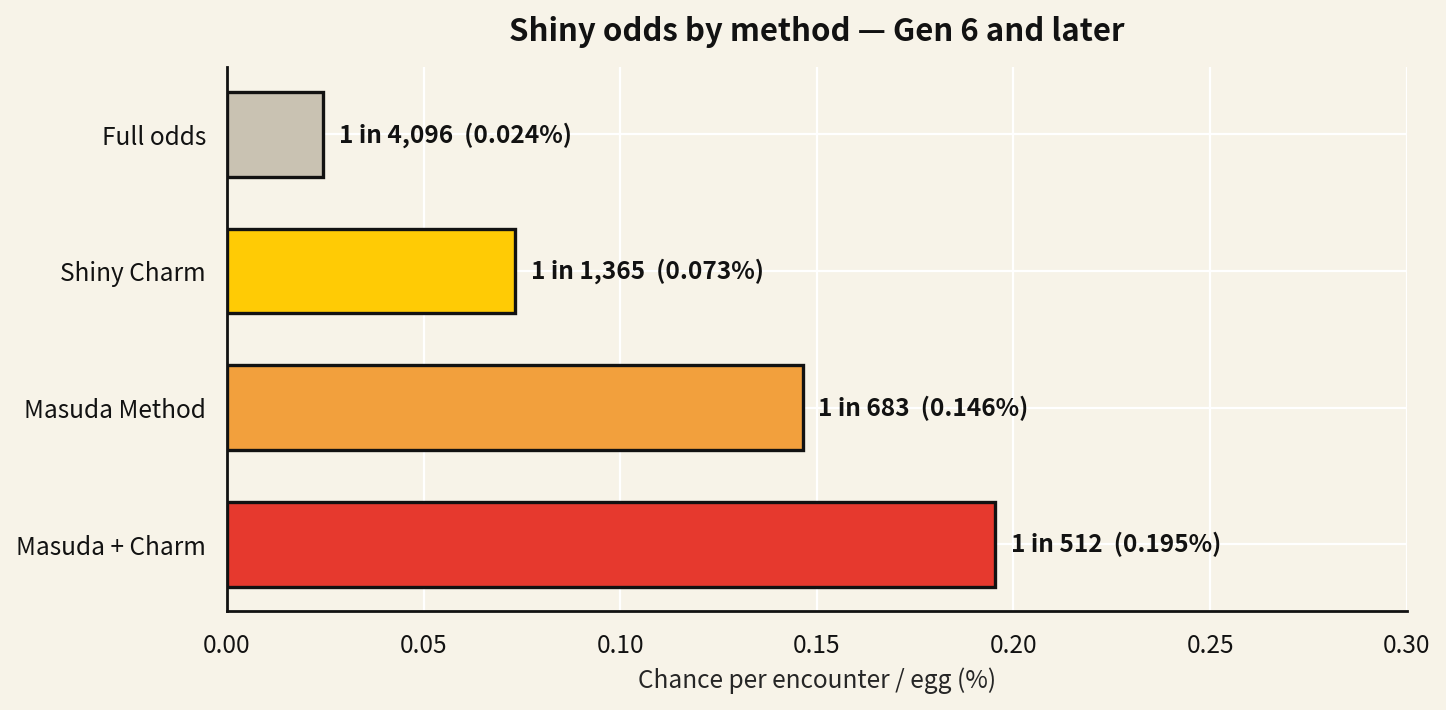
The same trick drives the modern outliers. Scarlet and Violet pile on Sparkling Power sandwiches and mass outbreaks. Legends: Arceus adds research levels and outbreak bonuses up to 32 rolls per spawn — 1 in 128, the best rate any mainline game has offered. Sword and Shield slipped in extra rolls after 500 battles with a species; that one was measured by the community rather than read from the code, so treat the exact figures as estimates — communities like r/ShinyPokemon keep live tallies on these methods. The pattern holds across all of them: every shiny hunting method ever shipped is extra rolls.
One caution before a long hunt, because this is where hunters burn out: these are per-encounter rates, not timers, as the long-running Smogon forums keep reminding first-time hunters. Even at 1/512 there's a 14.2% chance of a completely empty 1,000-egg stretch. Nothing is "due." Each roll starts fresh, so plan around the average and don't read meaning into a dry spell.
For your own setup — game, charm, Masuda, outbreak level — the Pokemon Shiny Odds calculator does this arithmetic directly: pick the conditions you actually have and it returns the rate, the average hunt length, and the chance of at least one shiny inside the session you're planning. Same math as above, just pointed at your hunt instead of the generic tables. For the dex data behind every rate, PokemonDB's national dex is the reference hunters cite most.