 Random Pokemon Generator
Dragonite Weakness (2x / 4x)
Ice 4x Rock Dragon Fairy
#149 · Dragon / Flying · Dragon Pokemon · Gen 1
Dragonite is the original pseudo-legendary, and it makes you wait for the privilege: two full stages as a Dratini and a Dragonair, then a level 55 arrival that turns a slim sea serpent into a 600-total tank.
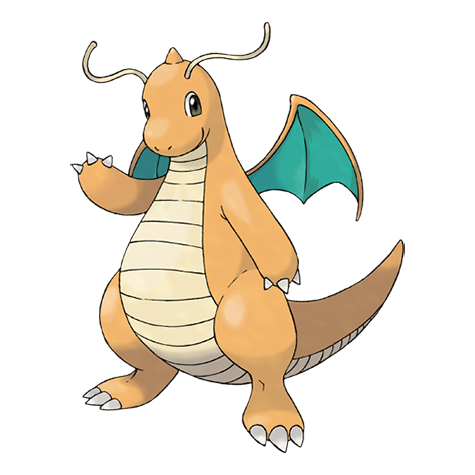
BST 600
Abilities: Inner Focus · Multiscale (hidden) · Evolution stage: final
The card above comes straight off the full 18-type grid on the Pokemon Type Chart, Ground immunity included.
Ice 4x Rock Dragon Fairy
Fire Water Grass 0.25x Fighting Bug
Ground
Charizard covers the other famous Gen 1 flyer, and Rayquaza shares this exact typing.
The first 600-total dragon
Number 149 closes out the Kanto dex behind Mewtwo, and it is a Dragon/Flying type from Generation 1. The route here is long: a Dratini first, then a Dragonair, and only at level 55 does the final stage show up. Its abilities are Inner Focus in front and Multiscale behind, and nothing evolves out of it after that.
The delay is part of the identity. Two evolutions and a level requirement that lands late in a normal playthrough mean most trainers spend the middle of the game carrying a slim blue serpent that has not paid off yet. The Pokedex entries lean into that patience: it is written as a rescuer, a Pokemon that guides lost ships home rather than one that hunts.
What arrives at level 55 is worth the wait. 600 base stat total, 134 Attack, and enough bulk to stand in front of most of the dex. It is one of the few Gen 1 Pokemon that still gets described as a threat rather than a nostalgia pick.
The combination produces a long list in both directions. Four types double up: Ice, Rock, Dragon and Fairy. Four come back at half: Fire, Water, Fighting and Bug. Grass is the odd one out at a quarter, because both halves of the typing resist it. Ground does nothing at all, which is the entry that matters most in ordinary fights, because Earthquake shows up on almost every physical attacker worth using.
Two types also means twice the exposure. Ice moves in particular deserve respect, since they hit the Dragon half and the Flying half at once and turn an otherwise sturdy Pokemon into a two-turn problem. The four weaknesses are all common coverage types rather than exotic ones, so a Dragonite on the field is always a Pokemon the opponent has an answer for.
The 134 in Attack is the headline, and it is backed by 91 HP, 95 Defense and 100 Special Defense. That is a Pokemon that hits hard and stays on the field long enough to hit again. The 100 Special Attack is a genuine second option rather than a decorative number, which is why special sets exist at all on a Pokemon built around a physical attack stat.
Speed is the weak column at 80. Dragonite will lose the first turn against most dedicated sweepers, so it plays as a wallbreaker or a bulky attacker rather than a revenge killer. Nothing about the spread is wasted, and nothing about it is fast.
The hidden ability is the one that changes how the Pokemon is played. Multiscale halves incoming damage while it sits at full health, which means the first hit of a battle lands for half of what the type chart suggests. Send it in at 100 percent and it survives attacks that should have removed it.
That makes healing and switch discipline part of the game plan rather than an afterthought. Inner Focus, the standard ability, prevents flinching instead, which is a quieter benefit. Either way, the ability slot is doing real work on every set, which is not something you can say about every Pokemon at this total.
Ice, Rock, Dragon and Fairy double up on it. Ground is a flat zero. Fire, Water, Fighting and Bug come back at half, and Grass at a quarter. Reading that list in a battle order is straightforward: Ice attacks are the first thing to track, and any Ground-type opponent is a free switch-in.
Because the resistance column is broad, Dragonite handles a lot of common attackers comfortably. The danger is coverage: a single Ice Beam on an otherwise harmless special attacker is enough to force it out, which is why the Pokemon tends to come in after the opponent's threats are known rather than at the start of a fight.
Between the level requirement and the rarity of the early stages, this is a Pokemon you plan for. Chart the run in the Nuzlocke Team Builder, use the Random Pokemon Picker when you still need encounters to fill out a route, then finalise the six in the Pokemon Team Picker.
Numbers next: lock the nature in with the Pokemon Nature Chart, then confirm the stat spread in the Pokemon IV Calculator. If a close call is not worth calculation, the Pokemon Wheel Spinner and Who's That Pokemon will settle it without a spreadsheet.
Colour variants live elsewhere in the suite: the base odds are in Pokemon Shiny Odds, the Random Shiny Pokemon Generator runs the hunt for you, and the Random Mega Pokemon Generator covers the forms that sit above the standard dex.
Most 600-total Pokemon are caught close to their final form, or arrive through a static encounter with a level attached. Dragonite is the opposite: the whole line is a project. Dratini is a rare find wherever it appears, Dragonair is a middle stage with its own fans, and the payoff only shows up near the end.
That structure is why the Pokemon still comes up in challenge runs. A run that commits to a Dratini is committing a route, a stack of experience and a long stretch of vulnerability to one future payoff. Few Pokemon in the dex carry that kind of bet with them.
Compared with its contemporaries, Dragonite is the balanced one. Mewtwo is faster and hits harder but folds to the right attacker, and the legendary birds trade durability for a single type. Dragonite keeps a foot in both camps: enough bulk to absorb a hit, enough Attack to make the return hit count.
That balance is also why it has aged well. Later generations added dragons with more extreme spreads and higher totals, and Dragonite kept its place regardless, because a 600 total spread this evenly is a hard thing to power creep out of a role.
FAQ
Dragonite is a Dragon and Flying type, which puts four weaknesses and five resistances on the sheet along with one immunity to Ground. It is the typing it shares with Rayquaza.
Ice, Rock, Dragon and Fairy all hit it for double damage, and Ice is the one to watch because it catches both halves of the typing at once. Ground attacks do nothing to it at all.
A Dratini becomes Dragonair at level 30 and a Dragonair becomes Dragonite at level 55. There is no item and no trade in the chain, only levels.
Inner Focus is the standard ability and Multiscale is the hidden one. Multiscale halves the damage of an incoming hit while it is at full health, which is why it is valued so highly on bulky sets.
Three stages, one line: Dratini, Dragonair, then Dragonite at level 55. Nothing evolves out of Dragonite, so the chart ends there.
Hitting hard while taking a hit. 134 Attack on top of 91 HP and a broad resistance list makes it a bulky attacker rather than a sweeper, and 80 Speed keeps it from being mistaken for one.